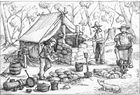
Building, by Andrew Swift
Details
Moonlighting, by Andrew Swift
Details
Panning, by Andrew Swift
Details
Smithy, by Andrew Swift
Details
Underground, by Andrew Swift
Details
Reverbatory Furnace, by Robert Kaufman
Details
Chlorination, by Robert Kaufman
Details
Cyaniding, by Robert Kaufman
Details
Concentrating Tables, by Robert Kaufman
Details
Puddling, by Robert Kaufman
Details
Read more
The very earliest gold extraction equipment used by diggers were the cradle and the gold pan, both of which used a rocking action to separate the gold from a mixture of gravel and water. The ore was retrieved directly from a pan, or from riffles (that trapped the gold within the apparatus) when a cradle was used.
As diggers began to settle more permanently on the goldfields they began mining in new ways that required additional land, expensive machinery, and a more systematic and scientific approach to the extraction of the ore. Groups of men formed themselves into companies (co-operative or public) to make use of mining methods such as puddling, quartz reef mining, deep lead mining, and various forms of sluicing. Some goldfields became focal points for new mining technology such as Ballarat (deep lead mining) and Bendigo (quartz reef mining).
With the development of provincial cities and towns, such as Ballarat, Bendigo, Castlemaine and Maryborough, large-scale and sophisticated infrastructure was developed to support the mining communities in central Victoria; railways and roads; active government outposts; libraries, theatres and art galleries; and stock exchanges were established.
Puddling operations led to considerable changes in the goldfield's landscape. 'Sludge' (the residue of puddled washdirt) choked watercourses and covered auriferous ground and roads. In some places special measures, such as the construction of sludge channels and the employment of workers to clear the watercourses (the cost borne by the proprietors of the puddling machines) were introduced to keep the channels running free. The peak period for puddling was from 1854 to the mid-1860s; after that, puddling declined in importance as suitable deposits were worked out or became too deeply buried by sludge to be economically worked. Puddling continued on some goldfields – such as Dunolly, Rushworth and Beaufort – well into the twentieth century.
During the 1860s, Ballarat continued to be the state’s focal point for deep lead mining with phenomenal gold yields at depths of 300 ft and over. The sustainability of deep lead mining had a pronounced effect on Ballarat. In fewer than 20 years a progressive, bustling city had arisen – with over 40,000 inhabitants; 56 churches; three town halls; 477 hotels; many large public buildings; 84 miles of made streets; 164 miles of footpaths; 15 miles of stone channelling; a reticulated water supply with 60 main water pipes; and a gas works with 50 miles of gas mains. Its main streets were lined with well-stocked, elegant shops and prosperous business premises. In and around the city were 11 banks, 13 breweries, eight iron foundries and three flour mills.
The ‘mining revolution’ transformed quartz reefing. The Bendigo field was at the forefront of the revolution, which precipitated the town’s transformation into a metropolis as rapidly as that which had occurred at Ballarat. The growing quartz mining industry was characterised by two types of performance: mines that produced spectacular yields for a short time; and those that gave steady, long-term returns, from mining at increasing depths. A vivid illustration of the latter was the experience of the Port Phillip Company (Clunes).
The Port Phillip Company was the state’s greatest quartz mine during the early 1860s. From an unpretentious start, by 1862 the proprietors found themselves in possession of a mine that had produced gold valued at over £400,000. The Port Phillip Company was incessant in its experiments in quartz reduction and amalgamation, employing a chemist to make careful analysis of the results obtained from the trials. The efforts of the Port Phillip Company established quartz reefing as the State’s most successful gold mining industry, and by the end of the decade, rich gold was being profitably recovered from depths of up to 600 ft.
The 1870s saw the demise of Ballarat’s deep lead industry but this was offset by a rise in prominence of new deep lead fields. Leading the way was the Maryborough goldfield and its flagship, the Duke and Timor Company. At its height, the company's proprietors boasted that nearly all the inhabitants of the surrounding towns of Timor and Bowenvale depended upon the mine for support. Elsewhere in the Maryborough district – at Alma, Majorca and Carisbrook – other significant deep lead centres developed. Perhaps the most significant event, however, was the discovery of gold at Spring Hill, near Creswick. The familiar scene of small company mining was enacted during the mid-1870s as the gold was traced down the hill and below the basalt plain. The main deep lead was traced northwards to Smeaton where, given the name the Berry Lead, it became synonymous with many of Victoria's richest deep lead mines. The Berry deep lead also holds a less enviable record. On 12 December 1882, a drive from the New Australasian Company's No. 2 shaft was flooded and 22 miners perished. To date, this is Australia's largest gold mining disaster.
Quartz reef mining was given a boost during the early 1880s with the introduction of the rock drill. Before its introduction, all holes required for blasting out horizontal mining tunnels (called cross-cuts) were cut by the technique of tap-and-hammer (one man held an iron drill, which the other hit with a hammer). Using this method, a team of two men took 10 hours to cut a horizontal blasting hole, 9 ft 3 ins in depth. Imported rock-drills could cut the same hole in one hour, so represented great saving in time and labour costs. Its introduction was due, at least in part, to a visit by Bendigo’s ‘Quartz King’, George Lansell, to the Nevada and California goldfields.
The rock-drill had a profound influence. Shafts were sunk deeper to enable further cross-cutting – by the end of the 1880s, 19 shafts on the Bendigo field were down to 2,000 ft. (Lansell’s 180 Mine approached a depth of 3,000 ft). Elsewhere other companies also prospered using the new technology: – the Magdala Company commenced driving towards an ore body and dominated Stawell's gold production until 1917; at St Arnaud, the Lord Nelson Company became a mighty gold producer; and the Maxwell (Inglewood), the North Cornish (Daylesford) and the North British (Maldon) companies also flourished.
Gold miners also began, for the first time, to extract gold from ore that was heavily laced with iron pyrites and other sulphides. This involved a chlorination process, using a combination of heat and chemicals; gold is readily attacked by chlorine gas and the chloride formed is soluble in water. Chlorine gas was generally used for the treatment of pyritical concentrates obtained from tailings. Physical evidence of the chlorination technology is now scarce in Victoria because, due to the toxic nature of the residues produced by the process, most sites have been ‘cleaned up’
David Bannear